 Lynx
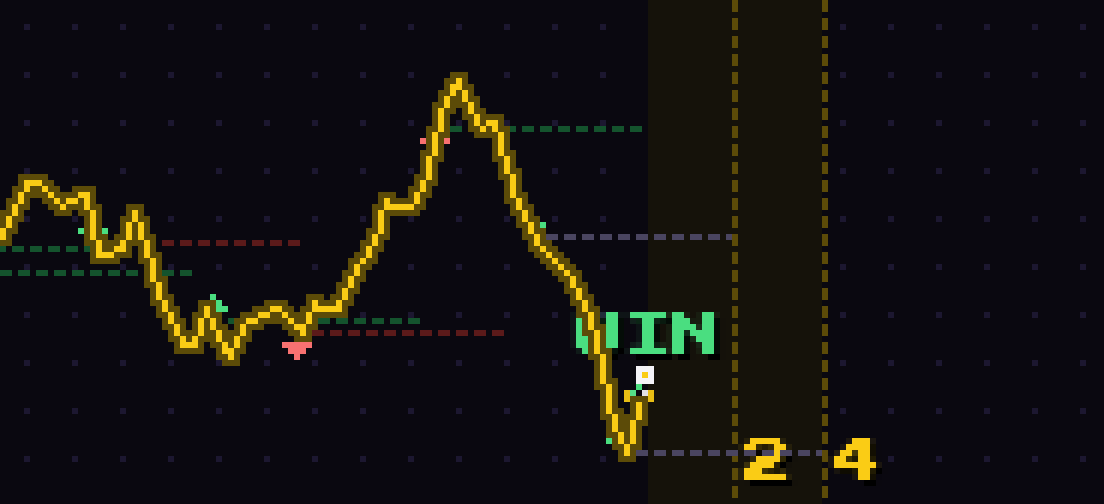
Call a market up or down, commit an entry before the round locks, and let a short stretch of live price action settle who wins. That is a crypto price prediction game at its simplest: a timed competition whose outcome depends on recorded market prices, with fixed rules that convert the price path or final price into a result.
This is different from a long-term “price prediction” article. It is also different from opening a leveraged perpetual position.
The core loop
Most price-based games need four elements:
- A defined market-price source.
- An entry window that closes before the result is known.
- A fixed rule for direction, range, path, or relative performance.
- A settlement rule for payouts, ties, failed price updates, and canceled rounds.
The price feed is an input, not an infallible referee. A complete game also needs freshness checks and failure rules for delayed or unavailable data.
Pyth documents how its oracle aggregates publisher prices and confidence intervals for applications that consume market data.
The common formats
Price prediction games commonly ask one of three questions. The most common is direction: will the settlement price finish above or below a reference price? Range and path games ask instead whether price enters, crosses, or stays inside a defined area during the round. A third family scores relative performance, rewarding whichever asset moves the most or whichever player produces the highest score from several choices.
The format label does not determine the payout. Two direction games can use different tie rules, fees, entry windows, and prize allocation.
What playing with real crypto changes
Using crypto changes the stakes and the transaction flow. Entries and payouts can have real value, so repeated short rounds can create substantial losses even when each entry is small.
A wallet connection does not prove funds remain in the wallet. A game may use approvals, a contract deposit, or an internal game-room balance controlled by the connected wallet.
On-chain transactions can make deposits, entries, and payouts inspectable. Price construction, game servers, operators, and front-end availability may still include off-chain components.
Entry amounts, fees, timing, supported assets, eligibility, and cancellation rules vary. The live room rules are the authoritative source for a specific round.
Prediction games vs leveraged trading
The two share a price feed and little else, and the differences are worth laying out plainly:
| Price prediction game | Leveraged perpetuals | |
|---|---|---|
| Loss shape | Usually limited by the committed entry under the game’s rules | Losses consume margin; position can be liquidated |
| Position management | None; commit and wait for settlement | Continuous: margin, funding, exits |
| Duration | Fixed, short rounds | Open-ended, trader-controlled |
| Sizing decisions | One: the stake | Several: notional, leverage, collateral |
| What you must be right about | One outcome by one deadline | Direction and path, surviving the moves in between |
A prediction round does not create the same open-ended margin process as a leveraged position. But the maximum loss still depends on the actual game rules, fees, and whether the player makes repeated entries.
For persistent positions, read the on-chain perpetual futures guide and the leverage guide before using a perpetual.
How Lynx Arcade works
Lynx Arcade runs short games on live crypto prices, played with real crypto from a game balance kept separate from perps margin. Games, stakes, and networks come from live configuration, so they can change without an article update.
Two of the games are single-player and played against the house, with no lobby and no wait for other players. In Gridy, you pick a square ahead of the price line: each square is a price band over a 5-second window, and a hit pays your stake times that square’s multiplier. In Uppy, you call the price up or down for 30 seconds, one minute, or two; the strike is set from the live price just after you call, with a small spread, and a right call pays 1.8× the stake. A weekly Gridy leaderboard ranks each player’s first 1,000 bets of the week.
Multiplayer rooms work differently. In Uppy rooms, everyone pays the same listed entry and starts with equal round credits, and the best score when the clock runs out takes the pot. Quicky is a 60-second race between coins: each rider claims one coin, and the rider whose coin posts the best percentage change takes the pot. Credits are round score, not a separate token balance.
The Lynx Arcade introduction covers the launch of the multiplayer rooms. The live app remains the source of truth for the games and terms available now.
Before entering a round
Check the entry amount, fee, timer, payout, tie rule, price source, supported network, and cancellation behavior. Confirm which wallet approval or deposit is being requested.
Treat an entry as money at risk, not as an investment. A fixed round does not remove loss risk, and quick settlement can make repeated entries feel smaller than their combined cost.
Sources
- Lynx: Introducing Lynx Arcade — first-party description of the lobby, shared balance, credits, and multiplayer rooms.
- Lynx Arcade — live games, stakes, room availability, and game rules.
- Pyth: How Pyth Works — oracle publishers, price aggregation, and confidence intervals.
This guide is educational and does not provide financial advice. Product availability and room configuration can change; check the live interface before depositing or entering.